

here is one question I ask everyone before I begin.
How do you like your pressure?
Some people answer straight away. Firm. As deep as you can go. Others hesitate, and then say, quietly, that they do not really like being pressed on. Both answers are useful to me, and neither is wrong. But the conversation that follows is often the most important part of the treatment, so I want to write it down properly here.
Why strong pressure feels so good
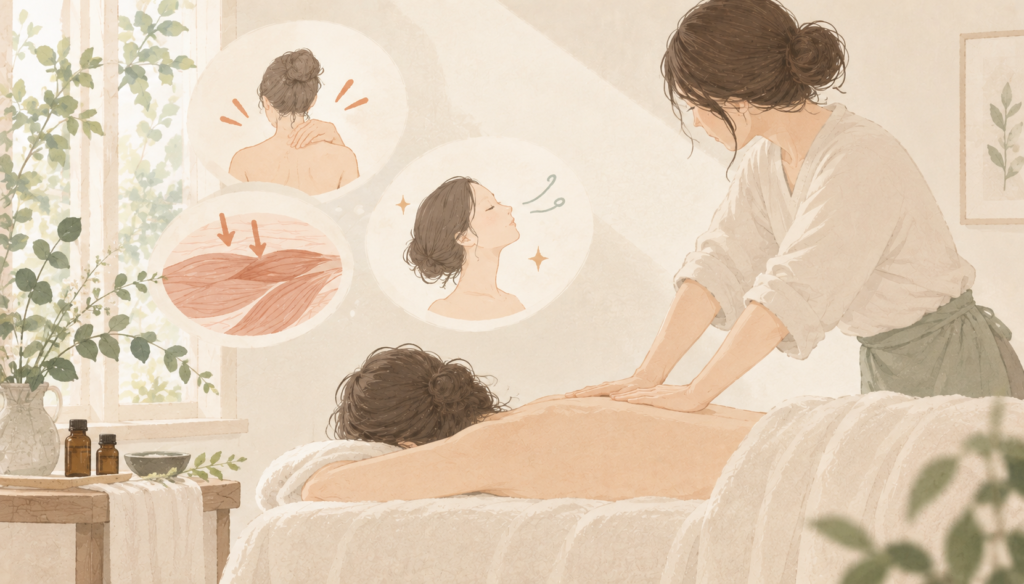
I want to be fair to deep work, because the people who ask for it are not imagining the feeling.
Firm pressure reaches the deeper sensors in your muscles and connective tissue, and the sensation is unmistakable. Something is clearly happening. There is also a well-known effect where a strong, steady sensation crowds out a duller ache underneath it — the reason we rub a knock, or press hard on a tight shoulder ourselves. That intense sensation is often followed by a flood of relief and a slightly floaty calm afterwards.
And there is an honest, human part of it too. Deep pressure feels like value. You can feel the work being done. You leave with proof.
So when someone tells me they want it strong, I understand exactly what they are asking for. What I offer them is a slightly different route to the same place.
What “it hurts” is actually telling us
Here is the part I explain to clients who want more.
Pain is a request, not a target. When a muscle is pressed harder than it is willing to accept, it does not surrender — it braces. The body protects itself. You can often feel it happening under your hands: the tissue meets you and pushes back. Working through that resistance is possible, but you are then working against a body that has decided you are a threat.
Soreness the next day is worth thinking about the same way. Tenderness after deep work means the tissue was stressed. Sometimes that is fine and settles in a day. But being sore is not itself proof that something good happened, and for some people — anyone with sensitive or easily bruised skin, anyone whose system is already exhausted, anyone under medical care — the stronger route is not the kinder one. If you have a condition or an injury, that is a conversation for your GP as much as for me.
This is why I stay at the edge of what the body will accept rather than past it. You will feel me. You will not have to endure me.
The case for a gentler touch
Now the part I actually want to write about, because it is the part most people have never had explained to them.
The body stops defending itself. Slow, steady, unhurried contact is read by the nervous system as safe. When the body decides it is safe, it lets go of a guarding pattern it may have been holding for weeks. Nothing has to be forced open, because nothing is being defended.
You drop into rest. Most of us arrive at a treatment still running at speed — traffic, messages, a list. Gentle rhythmic work is one of the few things that reliably shifts people out of that state and into the slower one where breathing deepens and the shoulders finally come down. People often fall asleep on my couch. I take it as a compliment.
You can feel more, not less. Strong pressure floods the senses, and everything quieter disappears underneath it. Work gently and the detail comes back: where you are actually tight, which side is different from the other, where you have not felt anything at all for a long time. Many clients discover the real problem area is nowhere near the one they came in complaining about.
Skin is not a surface to get past. Slow, light contact has its own dedicated pathway to the brain, the one associated with comfort and being cared for rather than with pressure and force. It is the reason a hand on a shoulder works. In a treatment room it is not a lesser version of massage. It is a different instrument.
The oils get their chance. I work with organic essential oils, and scent is not a background detail — it travels a direct route to the parts of the brain involved in memory and mood. A calm, unhurried treatment leaves room for that to be part of the experience rather than something you notice on the way out.
It suits more bodies. Gentle work can be offered to people who are tired, tender, older, very stressed, or simply new to being touched by a stranger. Nobody has to be brave. Nobody has to breathe through it.
And you leave intact. No bracing, no bruising, no stiff Saturday. Just a body that has been allowed to stop for an hour.
“But I still want to feel it”
Fair. Pressure and force are not the same thing, and I use plenty of the first.
I use my body weight rather than my strength, so the pressure arrives slowly and the muscle has time to say yes. I use a broad contact — a forearm rather than a thumb — which lets me go deeper without it ever feeling sharp. I follow your breath, and I wait. Tissue that is given a few seconds will usually open on its own, and then I can go further than I could have forced my way.
The result is a treatment that feels substantial, and a body that is not repairing itself afterwards.
How to ask for what you want

This works best when you tell me the truth, so a few phrases that help:
- That is the right depth — stay there.
- I can feel it, but I have started holding my breath. (This one matters. Breath-holding is the clearest sign we have gone past the edge.)
- Lighter on this side.
- I like to know what is happening — or — I would rather not talk.
None of it offends me. Every body is different on a different day, and the treatment belongs to you.
If you would like to try it
I am an IFPA-qualified aromatherapist based in Cambridge, working with organic essential oils and a pressure chosen with you rather than for you. If firm massage has ever left you sore, tense, or quietly enduring it, this is the other option.


コメント